




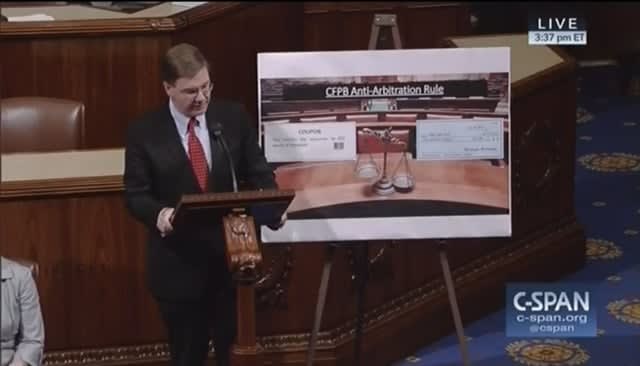
WASHINGTON, D.C. — On Tuesday, the House of Representatives passed a joint resolution of disapproval under the Congressional Rule Act to block the Consumer Financial Protection Bureau (CFPB)’s new rule banning mandatory arbitration clauses in finance contracts.
The Republican-controlled House approved the resolution by a 231 to 190 roll-call vote, with only one Republican, Rep. Walter Jones of North Carolina, voting against blocking the rule. The House resolution now heads to the Senate, where Republicans hold a slim 52 to 48 majority. Under CRA, the resolution must pass both houses by a simple majority and receive the president’s signature to repeal the rule.
“The CFPB rule, like so many other Washington rules and regulations, hurts the very people it is supposed to help,” said Rep. Keith Rothfus (R-Pa.), the resolution’s sponsor. “According to the CFPB’s own study, the average recovery for members of a class action lawsuit is a paltry $32, contrasted with the average $5,389 recovery for consumers who use arbitration. If we want to help ensure consumer recoveries and justice, depriving them of efficient and effective arbitration is not the answer.”
Rothfus introduced his bill on July 20, the day after the CFPB published its arbitration rule in the Federal Register. The publishing of the rule started the clock on the rule’s effective date, which is set for Sept. 18. It applies to contracts signed 180 days after the effective date, or March 19.
The Senate challenge was submitted the same day by U.S. Senate Banking Committee Chairman Mike Crapo (R-Idaho) and 23 other Republican Senators. It now sits in the Committee on Banking, Housing, and Urban Affairs.
Under the CFPB’s arbitration rule, companies can still include arbitration clauses in finance contracts. However, creditors subject to the rule can’t use arbitration to stop consumers from being part of a group action. The rule also includes specific language companies will need to use if they include an arbitration clause in a new contract.
The rule also requires companies to submit to the CFPB certain records, including initial claims and counterclaims, answers to these claims and counterclaims, and awards issued in arbitration. The bureau will also collect correspondence companies receive from arbitration administrators regarding a company’s nonpayment of arbitration fees and its failure to follow the arbitrator’s fairness standards.
Bureau officials said the collected materials, which must be submitted with appropriate redactions of personal information, will allow it to better understand and monitor arbitration. They will also be published on the bureau’s website beginning in July 2019.
The new rule applies to the major markets for consumer financial products and services overseen by the bureau, including those that lend money, store money, and move or exchange money. Congress already prohibits arbitration agreements in the residential mortgage market and has done the same in many forms of credit extended to servicemembers and their families.
Attorney Tom Hudson said the rule will impact dealers exempt from the bureau's jurisdiction under the Dodd-Frank Act indirectly, while nonexempt dealers will be impacted directly. The question is whether the rule permits the financing of a vehicle service contract — sold in both cash and credit transactions — containing an arbitration agreement barring class relief.
Congressional Republicans were quick to denounce the arbitration rule when it was first issued by the CFPB on July 10. In a statement issued the same day, Rep. Jeb Hensarling (R-Texas), who has crusaded against the CFPB as chairman of the House Financial Services Committee, called on Congress to reject the rule under the CRA.
“This bureaucratic rule will harm American consumers but thrill class action trial attorneys,” he said. “In releasing this rule today, Director Cordray ignored a prior request by the acting Comptroller of the Currency that he work with the OCC to resolve its potential safety and soundness concerns.”
In a July 10 letter addressed to CFPB Director Richard Cordray, Acting Comptroller of the Currency Keith Noreika asked the CFPB head to delay publishing the final arbitration rule in the Federal Register until his staff had a full and fair opportunity to analyze the CFPB data supporting its ban.
“As a prudential regulator for the federal banking system, the OCC should be granted the opportunity to conduct an independent review of the CFPB data to determine the safety and soundness implications of the final rule,” Noreika wrote.
Cordray responded two days later. “I was surprised to receive your letter,” he wrote, noting that the issuance of the rule marked the conclusion of a multiyear process that included the bureau’s completion of its arbitration study in March 2015. “The rulemaking process itself spanned more than two years. Throughout the process, the bureau consulted repeatedly with representatives of the staff of the Office of the Comptroller of the Currency, as well as the other prudential regulators, precisely to discuss ‘prudential, market, or systemic objectives by such agencies’ in accordance with Section 1022 of the Dodd-Frank Wall Street Reform and Consumer Protection Act.
“At no time during this process did anyone from the OCC express any suggestion that the rule that was under development could threaten the safety and soundness of the banking system,” he added, noting that OCC staff issued an email on June 26 confirming the agency has no comments after reviewing a draft of the rule. “Nor did you express any such concerns to me when we have met or spoken.”