Automotive Industry Sees New Vehicle Finance Shift Back to Pre-Pandemic Levels in Q2 2021
Overall, the data shows encouraging signs for the automotive finance market.
by Melinda Zabritski
October 12, 2021
Overall, the data shows encouraging signs for the automotive finance market.
IMAGE: Getty
4 min to read
The automotive finance market performed admirably during the pandemic, aided by strong incentives that kept it moving forward. Now, with Q2 2021 data, we can see a clearer picture of how COVID-19 impacted the market and the beginning of the return to more normal levels.
The most notable shifts were in new vehicle financing. In 2020, there was a large spike in the average new vehicle loan amount caused by a higher percentage of full-size trucks being financed, likely because of the heavy incentives that were offered. This leveled out in Q2 2021, as SUVs and crossover vehicles once again became the top segment financed. The average new vehicle loan amount was $35,163 in Q2 2021, down from the record high in Q2 2020 of $36,121.
Ad Loading...
To better understand the impacts of the pandemic, it’s helpful to not only do year-over-year comparisons, but to also look at Q2 2019 for context. Understanding the full context will be key to making the most strategic decisions as the market faces current challenges, such as the microchip shortage.
Two other areas returning to pre-pandemic levels are average interest rates and loan terms, which saw notable impacts from OEM incentives. The average new vehicle interest rate saw a notable drop between Q2 2019 and Q2 2020, from 5.7% to 3.95%, year-over-year. In Q2 of 2021, this saw a slight uptick, reaching 4.09%.
Looking at loan terms, the distribution is an indicator of the market returning to pre-pandemic levels. In Q2 2020, as part of incentive packages, we saw a notable increase in the percentage of loans falling into the 73- to 84-month category, with those terms making up 33.77% of new vehicle loans, compared to 30.28% in Q2 2019. We saw this diminish, coming in at 31.99% of loans in Q2 2021. Overall, the average loan term in Q2 2021 was 69.36 months, compared to 71.31 months in Q2 2020.
Consumer Preferences and Finance Trends
IMAGE: Experian
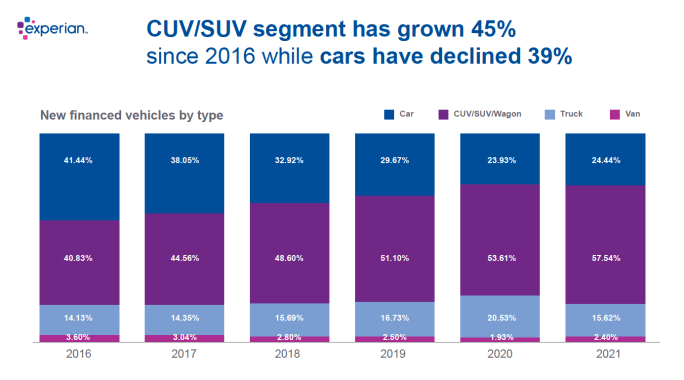
For some time now, the industry has been discussing affordability, and pointing to changing consumer preferences as one of the roots of the rising average vehicle loan amounts. The data demonstrates just how true this is for new vehicles. In Q2 2016, cars made up 41.44% of new vehicle financing, compared to 40.83% for SUV/CUVs, 14.13% for trucks, and 3.60% for vans. Since then, the most notable shift was in the SUV/CUV category, which now comprises 57.54% of financing, as of Q2 2021, while cars made up just 24.44%. The truck segment also saw some growth, reaching 15.62%, while vans decreased slightly to 2.4% in the same time frame.
Ad Loading...
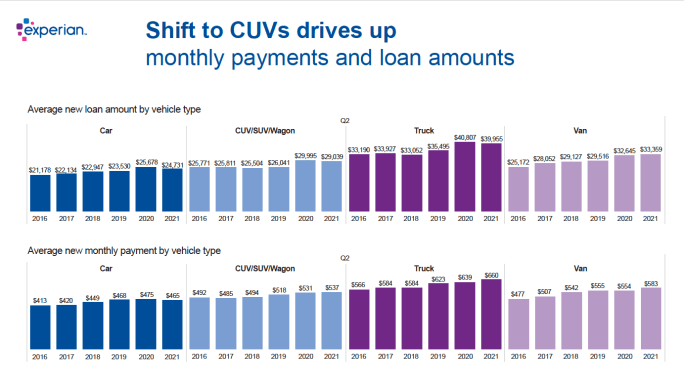
Looking at the average vehicle loan amount for these segments gives further context for the rising average vehicle loan amounts. In Q2 2016, the average loan amount for a car was $21,178, while an SUV/CUV was $25,771, and $33,190 for a truck. As of Q2 2021, the average new loan amount increased most notably for the truck segment, with the average new truck loan reaching $39,955. Cars and SUV/CUVs have seen increases in the same time frame, with the average car loan increasing to $24,731 and the average SUV/CUV loan reaching $29,039 as of Q2 2021.
IMAGE: Experian
In Q2 2021, the Honda CR-V was the most financed vehicle (2.93%), followed by the Chevrolet Silverado 1500 (2.6%) and the Honda Civic (2.51%). It’s important to keep in mind that these trends will continue to impact the used vehicle market for years to come, as the larger vehicles enter the used market.
Finance Market Share Levels Out
One of the biggest trends to come out of the pandemic was a significant jump in captive lenders’ market share of vehicle financing, as incentives helped keep the market moving forward. Now, this has shifted for both new and used financing, and we’re seeing things level out.
In the second quarter of 2021, all lenders saw increases in new vehicle financing market share, compared to captives, with the most significant growth occurring for banks. Banks increased from 22.81% in Q2 2020 to 27.28% in Q2 2021, while captives decreased to 55.33% in Q2 2021, from 62.21% in Q2 2020. Rounding out lender market share is credit unions (11.16%) and finance companies (4.77%). The alterations in captive and bank market share is another indicator of the market returning to more normal levels, which can be seen by comparing to Q2 2019, when captives comprised 54.34% and banks made up 27.64%.
Ad Loading...
For the used market, banks and finance companies saw growth vs. captives, with banks growing to 33.91% of financing, compared to 32.5% in Q2 2020. Finance companies increased market share from 16.04% in Q2 2020 to 16.48% in Q2 2021.
Overall, the data shows encouraging signs for the automotive finance market. As we face ongoing and new challenges, data will be crucial for enabling lenders to understand the market and make the most informed decisions for the future.
Melinda Zabritski is Experian’s senior director of automotive financial solutions.
American consumers might be happy to know that their preferred hybrids are slightly less impacted by extreme temperatures than fully electric vehicles, according to a new study.
NHTSA blames 10 deaths and two serious injuries on what its investigators believe were illegally imported air bag inflators. It’s taking public comments before deciding whether to ban them outright.
Albuquerque consumer who suffered a life-changing injury regains the use of his vehicle after Fiesta Volkswagen's service team shared his story with DOWC Cares.